Ensemble configurations
Hungarian Royal Gypsy Orchestra
40-piece ensemble
The 40-piece Hungarian Royal Gypsy Orchestra is our largest regularly available ensemble. Fourteen musicians in the first violin section, six each in the second violin, viola and double bass sections, four clarinettists and three cimbalom players are joined by one cellist. We recommend this ensemble for major festive concerts and cultural events. The programme and playing time are tailored to the occasion.
- 40 musicians
- 33 armless chairs
- 31 orchestra microphones
- 7 stage monitors
- Recommended stage size: 14 × 6 m
Hungarian Royal Gypsy Orchestra
30-piece ensemble
The 30-piece Hungarian Royal Gypsy Orchestra combines a rich string sound with four clarinets and three cimbaloms for a large-scale concert experience. We recommend it for festive occasions, standalone concerts and larger cultural events. The programme and playing time are tailored to the occasion.
- 30 musicians
- 25 armless chairs
- 26 orchestra microphones
- 7 stage monitors
- Recommended stage size: 14 × 6 m
Hungarian Royal Gypsy Orchestra
25-piece ensemble
The 25-piece Hungarian Royal Gypsy Orchestra combines a rich string sound with three cimbaloms and three clarinets for a festive concert experience. We recommend it for larger cultural events and standalone concerts. The programme and playing time are tailored to the occasion.
- 25 musicians
- 21 armless chairs
- 23 orchestra microphones
- 7 stage monitors
- Recommended stage size: 14 × 4 m
Hungarian Royal Gypsy Orchestra
17-piece ensemble
The 17-piece Hungarian Royal Gypsy Orchestra brings together strings, two cimbaloms and two clarinets in a varied concert programme. We recommend it for standalone concerts, festive occasions and cultural events. The programme and playing time are tailored to the occasion.
- 17 musicians
- 14 armless chairs
- 15 orchestra microphones
- 7 stage monitors
- Recommended stage size: 14 × 4 m
Hungarian Royal Gypsy Orchestra
7-piece ensemble
The seven-piece Hungarian Royal Gypsy Orchestra brings together violin, viola, cello, double bass, clarinet and cimbalom in a compact ensemble. We recommend it for smaller events, demonstrations, background music or accompaniment for dancing. The programme and playing time are tailored to the occasion.
- 7 musicians
- 5 armless chairs
- 8 orchestra microphones
- 1 stage monitors
- Recommended stage size: 7 × 3 m
Hungarian Royal Gypsy Orchestra
Custom ensemble
We can create a custom orchestra ensemble for your event. The number of musicians, instrument balance, programme and venue requirements are agreed with the client. A written production description is prepared for the final ensemble.
Production Information
40-piece ensemble
The 40-piece Hungarian Royal Gypsy Orchestra is our largest regularly available ensemble. Fourteen musicians in the first violin section, six each in the second violin, viola and double bass sections, four clarinettists and three cimbalom players are joined by one cellist. We recommend this ensemble for major festive concerts and cultural events. The programme and playing time are tailored to the occasion.
- 40 musicians
- 33 armless chairs
- 31 orchestra microphones
- 7 stage monitors
- Recommended stage size: 14 × 6 m
Programme
Instrumentation
1 primás (lead violinist) and 13 additional first violinists – 14 musicians in the first violin section in total
6 second violinists
6 viola players
1 cellist
6 double bass players
4 clarinettists
3 cimbalom players
40 musicians in total. The lead violinist is included in the stated size of the first violin section. Guest artists may be arranged separately.
Programme formats and repertoire
We offer standalone stage concerts, festive and themed programmes, cultural events, school demonstrations, background music for events and accompaniment for dancing. The programme is tailored to the occasion, the audience and the booking request.
The repertoire includes traditional Hungarian Gypsy music, csárdás, Hungarian dances, operetta selections and popular classical works. Examples: Ferenc Erkel – Palotás; Brahms – Hungarian Dances; Franz Liszt – Hungarian Rhapsody No. 2; Johann Strauss – The Blue Danube; Vittorio Monti – Csárdás; Grigoraș Dinicu – The Lark.
Individual programme requests, guest artists and the named performers to be advertised are agreed in advance.
Playing time and intervals
Shorter event or demonstration programme: usually 45 minutes.
Standalone concert: usually two 45-minute sets with a 15-minute interval; approximately 105 minutes in total.
The exact playing time, number of sets and breaks are agreed to suit the event.
Stage and seating
Stage arrangement
Recommended stage size: 14 metres wide × 6 metres deep. This is a planning recommendation. The final layout and venue suitability are agreed in advance.
Viewed from the audience, the lead violinist stands at the front centre. First violins are on the left, with second violins and violas on the right. The cello is centrally placed behind the lead violinist. The 3 cimbaloms occupy the rear centre, the clarinets the area in front of the cimbaloms and the double basses the rear right.
The stage must be dry, stable and safely accessible. Allow sufficient space between instruments and technical equipment for playing and clear access routes. Loading access and any risers are agreed separately.
Chairs and other equipment
The organiser provides 33 armless chairs. The lead violinist and double bass players perform standing, requiring 7 standing positions in total.
Armless chairs are also suitable for the cimbalom players and cellist; no special seating is required. Music stands are used only by prior request; the required number will be confirmed separately.
Outdoor requirements
A covered stage is required for every outdoor performance. In windy conditions or light rain, enclosed sides must protect the musicians and their instruments.
Outdoor performances with the acoustic instruments are not possible at temperatures below 18 °C. The stage must remain dry and stable. The suitability of the venue and the weather conditions is agreed in advance.
Sound and lighting
Microphones and sound reinforcement
Amplified performances require 31 orchestra microphones in total:
3 for soloists / lead violinists
6 for first violins
3 for second violins
6 for the 3 cimbaloms – 2 per instrument
2 for clarinets
4 for violas
6 for double basses
1 for the cello
Stand-mounted microphones are the default arrangement. Suspended microphones may be used where suitable rigging is available and the technician agrees this with the orchestra in advance. Microphone types, stands, cabling and the final input list are agreed with the venue technician.
Microphones for guest singers or other additional performers are agreed separately and are additional to these 31 microphones.
A concert hall with suitable acoustics may allow an unamplified performance. Amplification is required in theatre venues and outdoors. The organiser provides a suitable PA system and sound technician.
Stage monitor placement
7 stage monitors are required: 3 at the front of the stage facing the musicians; 1 on each side in the middle of the stage; and 2 behind the orchestra.
Exact positions, monitor mixes and levels are agreed with the venue technician.
Lighting and power supply
The organiser provides suitable stage lighting for the musicians. There are no fixed special lighting requirements; lighting is agreed to suit the venue and the event.
The venue technician plans power supplies, connections, distribution and cabling for the sound and lighting equipment. Cables must not obstruct the musicians or access to the stage.
Organisation and contact
Load-in, soundcheck and load-out
Indicative timings at the venue:
Loading in and moving into dressing rooms: approximately 35 minutes.
Setting up and adjusting the orchestra sound: approximately 35–40 minutes.
With a guest singer, allow an additional 10–15 minutes depending on their requirements.
Striking and loading out: approximately 45 minutes, including vacating dressing rooms.
No separate sound rehearsal is needed if the sound setup is satisfactory. These are general estimates; arrival, time allowances and changeovers between performers are agreed for the specific ensemble and event.
Travel, dressing room, hospitality and accommodation
The orchestra travels from Budapest. This ensemble travels with 40 musicians; any guest artists or accompanying organiser or manager are included in the total travelling party by separate agreement. We do not bring technical crew; the client provides the venue technician.
Performances are available throughout Hungary, abroad and on multi-day tours. Travel and instrument transport arrangements are set out in the quotation. Please provide loading access and parking as close to the venue as possible.
The organiser provides dressing rooms suitable for the number of musicians. We request mineral water, soft drinks and coffee; sandwiches for longer journeys; and a hot dinner after the concert.
For distant venues or multi-day tours, the client provides accommodation. Room allocation, the number of nights and individual catering needs are agreed in advance.
Enquiries and booking terms
Each performance is quoted individually. Please include the proposed date, venue, event type, chosen ensemble and required playing time in your enquiry. Where possible, contact us one to two months before the event.
The performance is confirmed once both parties have signed the contract. Public announcements may follow confirmation.
Travel and instrument transport may be included in the quotation as agreed. The client provides any required accommodation and covers the fees of requested guest artists. Technical services and other commitments are recorded in the quotation and contract, together with payment, cancellation and weather terms.
Photography, recording and broadcasting
Concert photography, audio or video recording and live streaming are possible by prior mutual agreement between the orchestra and the organiser. Proposed recording, use and publication arrangements must be agreed with Lajos Baranyai.
Contact
Contact for bookings and artistic, organisational or technical enquiries: Lajos Baranyai.
Please use the contact details or booking enquiry form on the Contact page of our website. Arrangements are discussed in Hungarian; assistance is provided for enquiries in other languages.
Seating plan
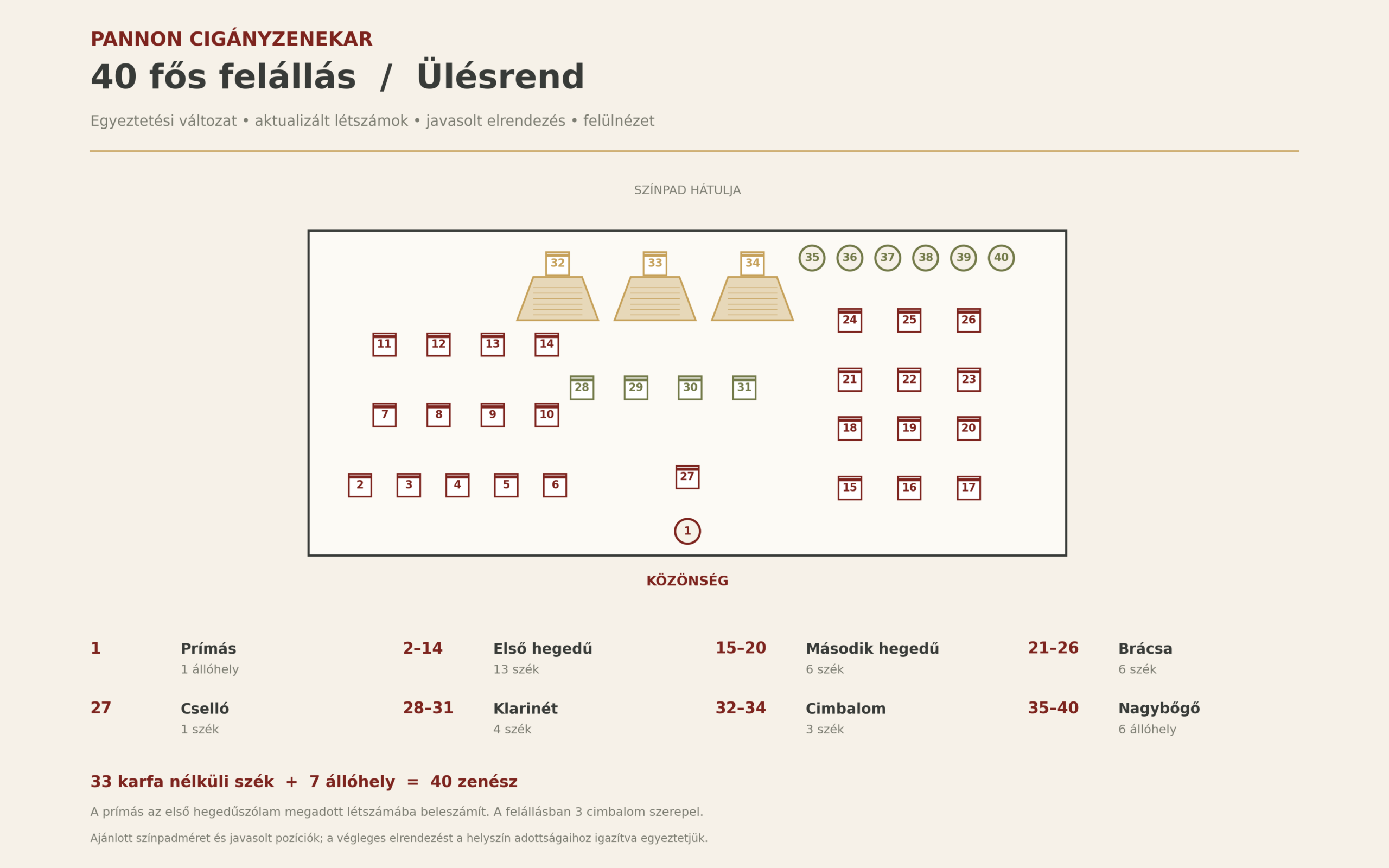
Proposed seating plan for the 40-piece ensemble, viewed from the audience. The musicians require 33 armless chairs and 7 standing positions. The arrangement is agreed to suit the venue.
Technical stage plan
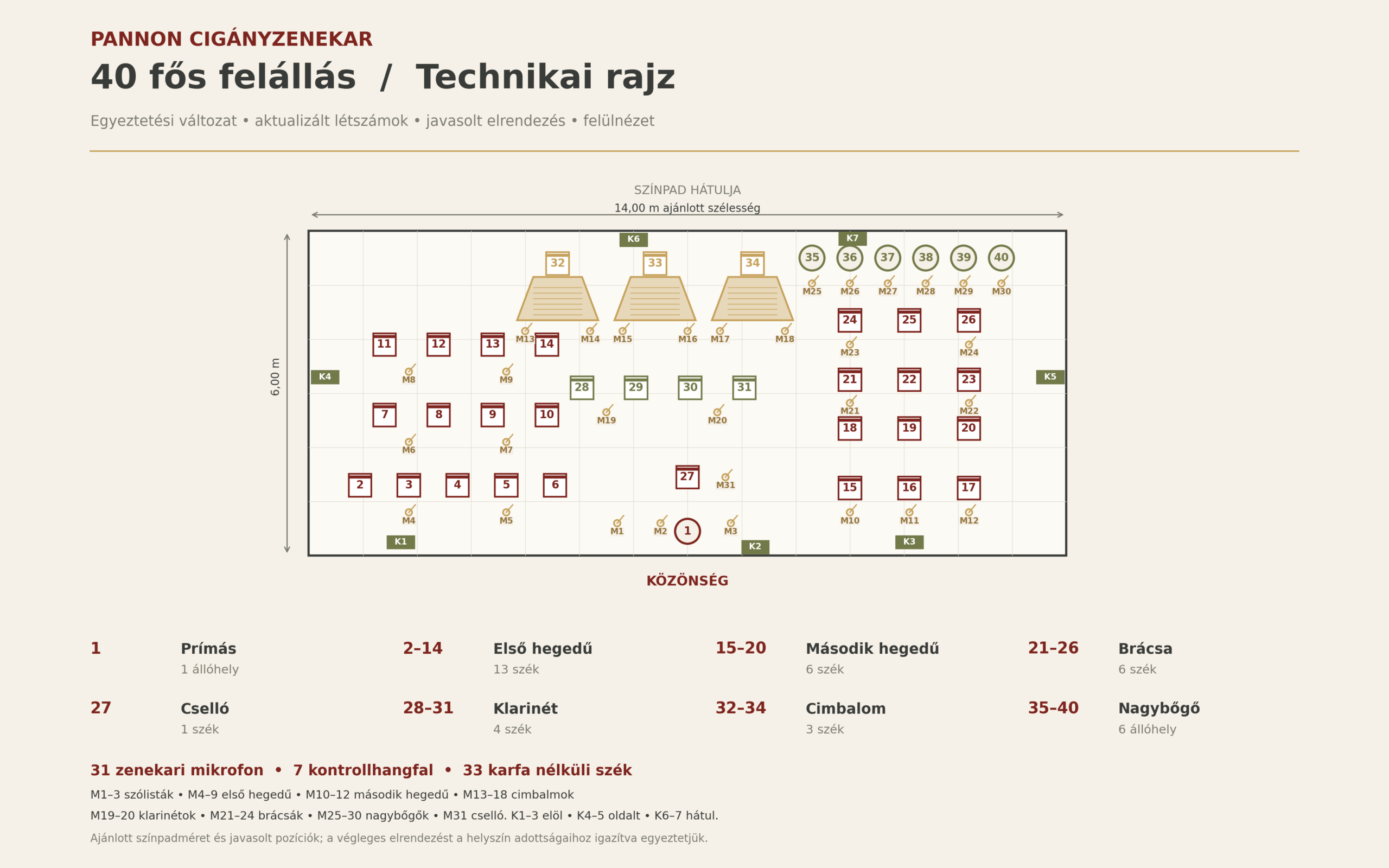
Proposed technical layout for the 40-piece Hungarian Royal Gypsy Orchestra. Recommended stage size: 14 metres wide × 6 metres deep; 33 armless chairs, 7 standing positions, 31 orchestra microphones and 7 stage monitors.
Microphone allocation by instrument and monitor positions are set out in the technical description. Additional microphones for guest artists are agreed separately. The final microphone setup, equipment positions and cabling are agreed with the venue technical team.
3D stage visualisation
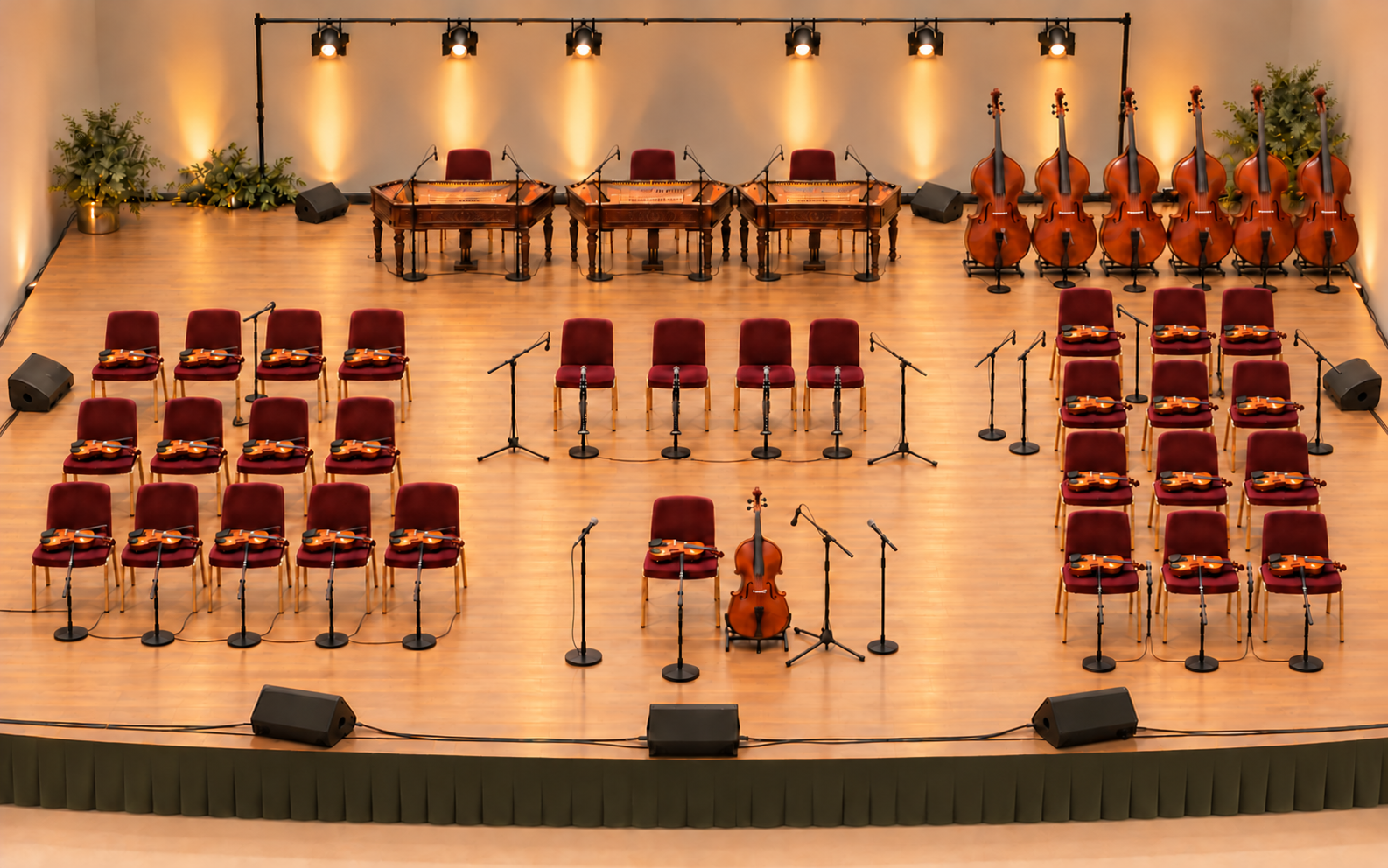
Illustrative stage visualisation for the 40-piece ensemble, with 3 cimbaloms and stage equipment. The image shows the stage before the performance, without musicians. The final layout, lighting and equipment are agreed to suit the venue; the precise requirements are set out in the written description and technical stage plan.
Production Information
30-piece ensemble
The 30-piece Hungarian Royal Gypsy Orchestra combines a rich string sound with four clarinets and three cimbaloms for a large-scale concert experience. We recommend it for festive occasions, standalone concerts and larger cultural events. The programme and playing time are tailored to the occasion.
- 30 musicians
- 25 armless chairs
- 26 orchestra microphones
- 7 stage monitors
- Recommended stage size: 14 × 6 m
Programme
Instrumentation
1 primás (lead violinist) and 10 additional first violinists – 11 musicians in the first violin section in total
3 second violinists
4 viola players
1 cellist
4 double bass players
4 clarinettists
3 cimbalom players
30 musicians in total. The lead violinist is included in the stated size of the first violin section. Guest artists may be arranged separately.
Programme formats and repertoire
We offer standalone stage concerts, festive and themed programmes, cultural events, school demonstrations, background music for events and accompaniment for dancing. The programme is tailored to the occasion, the audience and the booking request.
The repertoire includes traditional Hungarian Gypsy music, csárdás, Hungarian dances, operetta selections and popular classical works. Examples: Ferenc Erkel – Palotás; Brahms – Hungarian Dances; Franz Liszt – Hungarian Rhapsody No. 2; Johann Strauss – The Blue Danube; Vittorio Monti – Csárdás; Grigoraș Dinicu – The Lark.
Individual programme requests, guest artists and the named performers to be advertised are agreed in advance.
Playing time and intervals
Shorter event or demonstration programme: usually 45 minutes.
Standalone concert: usually two 45-minute sets with a 15-minute interval; approximately 105 minutes in total.
The exact playing time, number of sets and breaks are agreed to suit the event.
Stage and seating
Stage arrangement
Recommended stage size: 14 metres wide × 6 metres deep. This is a planning recommendation. The final layout and venue suitability are agreed in advance.
Viewed from the audience, the lead violinist stands at the front centre. First violins are on the left, with second violins and violas on the right. The cello is centrally placed behind the lead violinist. The 3 cimbaloms occupy the rear centre, the clarinets the area in front of the cimbaloms and the double basses the rear right.
The stage must be dry, stable and safely accessible. Allow sufficient space between instruments and technical equipment for playing and clear access routes. Loading access and any risers are agreed separately.
Chairs and other equipment
The organiser provides 25 armless chairs. The lead violinist and double bass players perform standing, requiring 5 standing positions in total.
Armless chairs are also suitable for the cimbalom players and cellist; no special seating is required. Music stands are used only by prior request; the required number will be confirmed separately.
Outdoor requirements
A covered stage is required for every outdoor performance. In windy conditions or light rain, enclosed sides must protect the musicians and their instruments.
Outdoor performances with the acoustic instruments are not possible at temperatures below 18 °C. The stage must remain dry and stable. The suitability of the venue and the weather conditions is agreed in advance.
Sound and lighting
Microphones and sound reinforcement
Amplified performances require 26 orchestra microphones in total:
3 for soloists / lead violinists
5 for first violins
2 for second violins
6 for the 3 cimbaloms – 2 per instrument
2 for clarinets
3 for violas
4 for double basses
1 for the cello
Stand-mounted microphones are the default arrangement. Suspended microphones may be used where suitable rigging is available and the technician agrees this with the orchestra in advance. Microphone types, stands, cabling and the final input list are agreed with the venue technician.
Microphones for guest singers or other additional performers are agreed separately and are additional to these 26 microphones.
A concert hall with suitable acoustics may allow an unamplified performance. Amplification is required in theatre venues and outdoors. The organiser provides a suitable PA system and sound technician.
Stage monitor placement
7 stage monitors are required: 3 at the front of the stage facing the musicians; 1 on each side in the middle of the stage; and 2 behind the orchestra.
Exact positions, monitor mixes and levels are agreed with the venue technician.
Lighting and power supply
The organiser provides suitable stage lighting for the musicians. There are no fixed special lighting requirements; lighting is agreed to suit the venue and the event.
The venue technician plans power supplies, connections, distribution and cabling for the sound and lighting equipment. Cables must not obstruct the musicians or access to the stage.
Organisation and contact
Load-in, soundcheck and load-out
Indicative timings at the venue:
Loading in and moving into dressing rooms: approximately 35 minutes.
Setting up and adjusting the orchestra sound: approximately 35–40 minutes.
With a guest singer, allow an additional 10–15 minutes depending on their requirements.
Striking and loading out: approximately 45 minutes, including vacating dressing rooms.
No separate sound rehearsal is needed if the sound setup is satisfactory. These are general estimates; arrival, time allowances and changeovers between performers are agreed for the specific ensemble and event.
Travel, dressing room, hospitality and accommodation
The orchestra travels from Budapest. This ensemble travels with 30 musicians; any guest artists or accompanying organiser or manager are included in the total travelling party by separate agreement. We do not bring technical crew; the client provides the venue technician.
Performances are available throughout Hungary, abroad and on multi-day tours. Travel and instrument transport arrangements are set out in the quotation. Please provide loading access and parking as close to the venue as possible.
The organiser provides dressing rooms suitable for the number of musicians. We request mineral water, soft drinks and coffee; sandwiches for longer journeys; and a hot dinner after the concert.
For distant venues or multi-day tours, the client provides accommodation. Room allocation, the number of nights and individual catering needs are agreed in advance.
Enquiries and booking terms
Each performance is quoted individually. Please include the proposed date, venue, event type, chosen ensemble and required playing time in your enquiry. Where possible, contact us one to two months before the event.
The performance is confirmed once both parties have signed the contract. Public announcements may follow confirmation.
Travel and instrument transport may be included in the quotation as agreed. The client provides any required accommodation and covers the fees of requested guest artists. Technical services and other commitments are recorded in the quotation and contract, together with payment, cancellation and weather terms.
Photography, recording and broadcasting
Concert photography, audio or video recording and live streaming are possible by prior mutual agreement between the orchestra and the organiser.
Proposed recording, use and publication arrangements must be agreed with Lajos Baranyai.
Contact
Contact for bookings and artistic, organisational or technical enquiries: Lajos Baranyai.
Please use the contact details or booking enquiry form on the Contact page of our website. Arrangements are discussed in Hungarian; assistance is provided for enquiries in other languages.
Seating plan
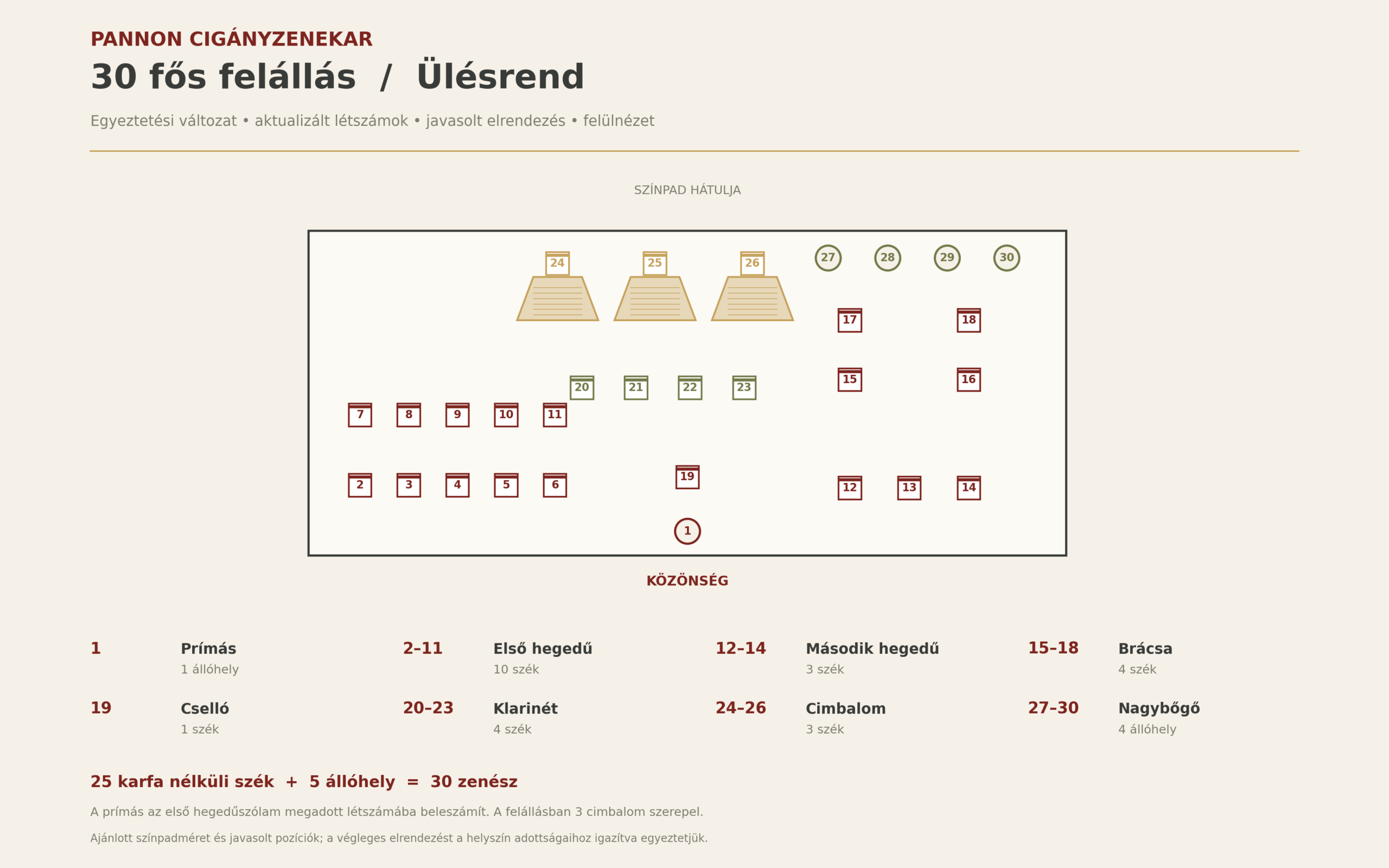
Proposed seating plan for the 30-piece ensemble, viewed from the audience. The musicians require 25 armless chairs and 5 standing positions. The arrangement is agreed to suit the venue.
Technical stage plan
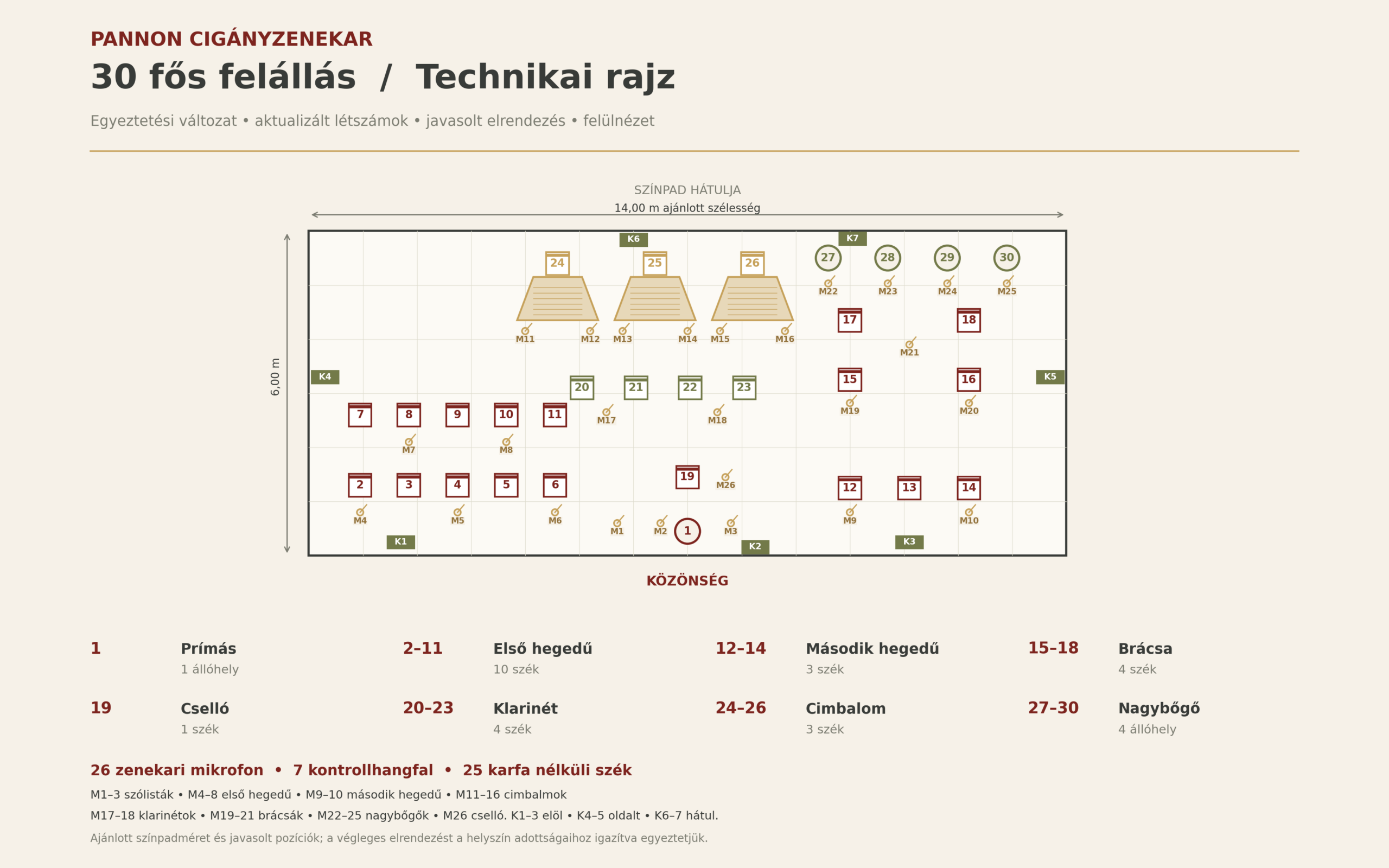
Proposed technical layout for the 30-piece Hungarian Royal Gypsy Orchestra. Recommended stage size: 14 metres wide × 6 metres deep; 25 armless chairs, 5 standing positions, 26 orchestra microphones and 7 stage monitors.
Microphone allocation by instrument and monitor positions are set out in the technical description. Additional microphones for guest artists are agreed separately. The final microphone setup, equipment positions and cabling are agreed with the venue technical team.
3D stage visualisation
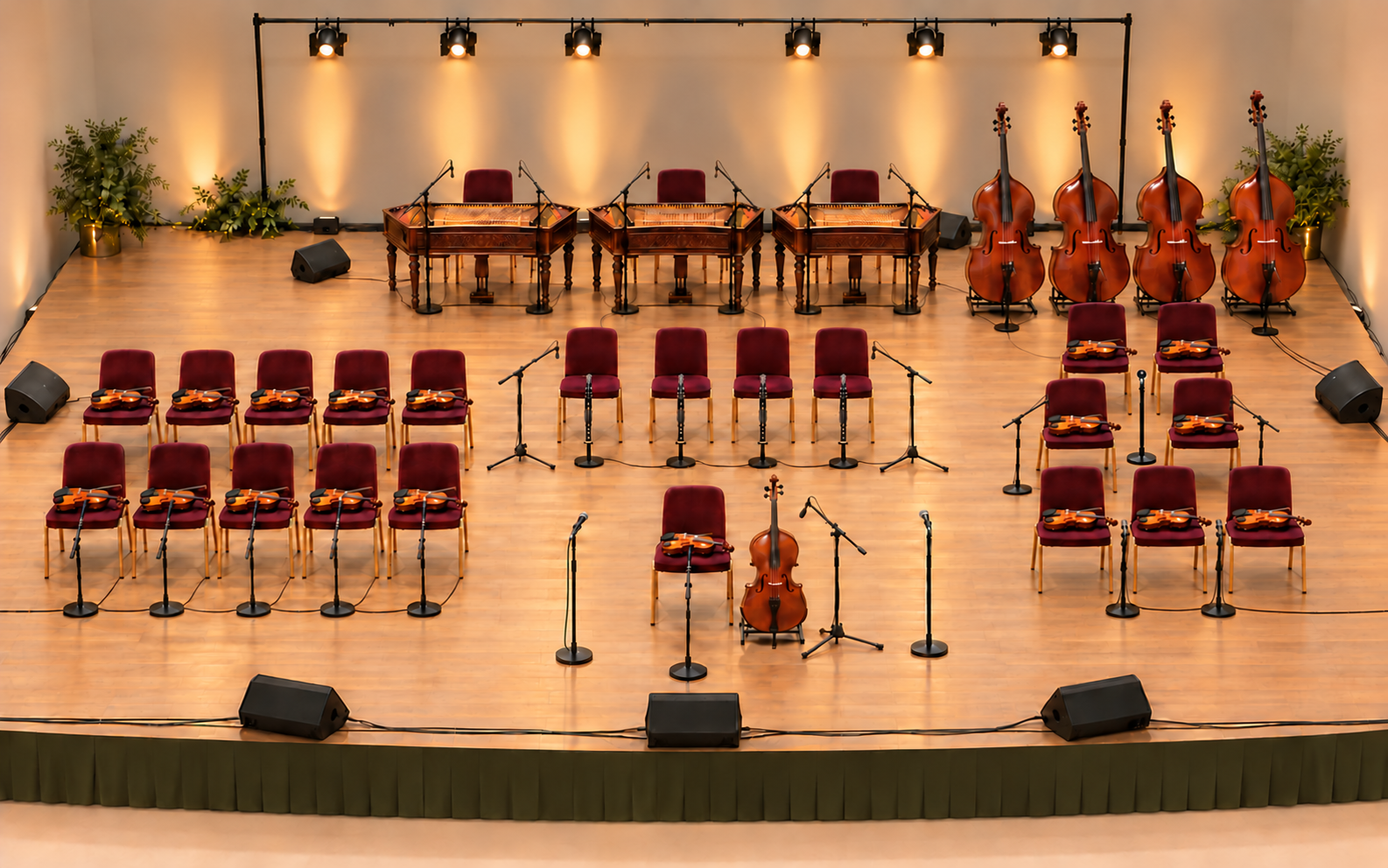
Illustrative stage visualisation for the 30-piece ensemble, with 3 cimbaloms and stage equipment. The image shows the stage before the performance, without musicians. The final layout, lighting and equipment are agreed to suit the venue; the precise requirements are set out in the written description and technical stage plan.
Production Information
25-piece ensemble
The 25-piece Hungarian Royal Gypsy Orchestra combines a rich string sound with three cimbaloms and three clarinets for a festive concert experience. We recommend it for larger cultural events and standalone concerts. The programme and playing time are tailored to the occasion.
- 25 musicians
- 21 armless chairs
- 23 orchestra microphones
- 7 stage monitors
- Recommended stage size: 14 × 4 m
Programme
Instrumentation
1 primás (lead violinist) and 8 additional first violinists – 9 musicians in the first violin section in total
3 second violinists
3 viola players
1 cellist
3 double bass players
3 clarinettists
3 cimbalom players
25 musicians in total. The lead violinist is included in the stated size of the first violin section. Guest artists may be arranged separately.
Programme formats and repertoire
We offer standalone stage concerts, festive and themed programmes, cultural events, school demonstrations, background music for events and accompaniment for dancing. The programme is tailored to the occasion, the audience and the booking request.
The repertoire includes traditional Hungarian Gypsy music, csárdás, Hungarian dances, operetta selections and popular classical works. Examples: Ferenc Erkel – Palotás; Brahms – Hungarian Dances; Franz Liszt – Hungarian Rhapsody No. 2; Johann Strauss – The Blue Danube; Vittorio Monti – Csárdás; Grigoraș Dinicu – The Lark.
Individual programme requests, guest artists and the named performers to be advertised are agreed in advance.
Playing time and intervals
Shorter event or demonstration programme: usually 45 minutes.
Standalone concert: usually two 45-minute sets with a 15-minute interval; approximately 105 minutes in total.
The exact playing time, number of sets and breaks are agreed to suit the event.
Stage and seating
Stage arrangement
Recommended stage size: 14 metres wide × 4 metres deep. This is a planning recommendation. The final layout and venue suitability are agreed in advance.
Viewed from the audience, the lead violinist stands at the front centre. First violins are on the left, with second violins and violas on the right. The cello is centrally placed behind the lead violinist. The 3 cimbaloms occupy the rear centre, the clarinets the area in front of the cimbaloms and the double basses the rear right.
The stage must be dry, stable and safely accessible. Allow sufficient space between instruments and technical equipment for playing and clear access routes. Loading access and any risers are agreed separately.
Chairs and other equipment
The organiser provides 21 armless chairs. The lead violinist and double bass players perform standing, requiring 4 standing positions in total.
Armless chairs are also suitable for the cimbalom players and cellist; no special seating is required. Music stands are used only by prior request; the required number will be confirmed separately.
Outdoor requirements
A covered stage is required for every outdoor performance. In windy conditions or light rain, enclosed sides must protect the musicians and their instruments.
Outdoor performances with the acoustic instruments are not possible at temperatures below 18 °C. The stage must remain dry and stable. The suitability of the venue and the weather conditions is agreed in advance.
Sound and lighting
Microphones and sound reinforcement
Amplified performances require 23 orchestra microphones in total:
3 for soloists / lead violinists
4 for first violins
2 for second violins
6 for the 3 cimbaloms – 2 per instrument
2 for clarinets
2 for violas
3 for double basses
1 for the cello
Stand-mounted microphones are the default arrangement. Suspended microphones may be used where suitable rigging is available and the technician agrees this with the orchestra in advance. Microphone types, stands, cabling and the final input list are agreed with the venue technician.
Microphones for guest singers or other additional performers are agreed separately and are additional to these 23 microphones.
A concert hall with suitable acoustics may allow an unamplified performance. Amplification is required in theatre venues and outdoors. The organiser provides a suitable PA system and sound technician.
Stage monitor placement
7 stage monitors are required: 3 at the front of the stage facing the musicians; 1 on each side in the middle of the stage; and 2 behind the orchestra.
Exact positions, monitor mixes and levels are agreed with the venue technician.
Lighting and power supply
The organiser provides suitable stage lighting for the musicians. There are no fixed special lighting requirements; lighting is agreed to suit the venue and the event.
The venue technician plans power supplies, connections, distribution and cabling for the sound and lighting equipment. Cables must not obstruct the musicians or access to the stage.
Organisation and contact
Load-in, soundcheck and load-out
Indicative timings at the venue:
– Loading in and moving into dressing rooms: approximately 35 minutes.
– Setting up and adjusting the orchestra sound: approximately 35–40 minutes.
– With a guest singer, allow an additional 10–15 minutes depending on their requirements.
– Striking and loading out: approximately 45 minutes, including vacating dressing rooms.
No separate sound rehearsal is needed if the sound setup is satisfactory. These are general estimates; arrival, time allowances and changeovers between performers are agreed for the specific ensemble and event.
Travel, dressing room, hospitality and accommodation
The orchestra travels from Budapest. This ensemble travels with 25 musicians; any guest artists or accompanying organiser or manager are included in the total travelling party by separate agreement. We do not bring technical crew; the client provides the venue technician.
Performances are available throughout Hungary, abroad and on multi-day tours. Travel and instrument transport arrangements are set out in the quotation. Please provide loading access and parking as close to the venue as possible.
The organiser provides dressing rooms suitable for the number of musicians. We request mineral water, soft drinks and coffee; sandwiches for longer journeys; and a hot dinner after the concert.
For distant venues or multi-day tours, the client provides accommodation. Room allocation, the number of nights and individual catering needs are agreed in advance.
Enquiries and booking terms
Each performance is quoted individually. Please include the proposed date, venue, event type, chosen ensemble and required playing time in your enquiry. Where possible, contact us one to two months before the event.
The performance is confirmed once both parties have signed the contract. Public announcements may follow confirmation.
Travel and instrument transport may be included in the quotation as agreed. The client provides any required accommodation and covers the fees of requested guest artists. Technical services and other commitments are recorded in the quotation and contract, together with payment, cancellation and weather terms.
Photography, recording and broadcasting
Concert photography, audio or video recording and live streaming are possible by prior mutual agreement between the orchestra and the organiser. Proposed recording, use and publication arrangements must be agreed with Lajos Baranyai.
Contact
Contact for bookings and artistic, organisational or technical enquiries: Lajos Baranyai.
Please use the contact details or booking enquiry form on the Contact page of our website. Arrangements are discussed in Hungarian; assistance is provided for enquiries in other languages.
Seating plan
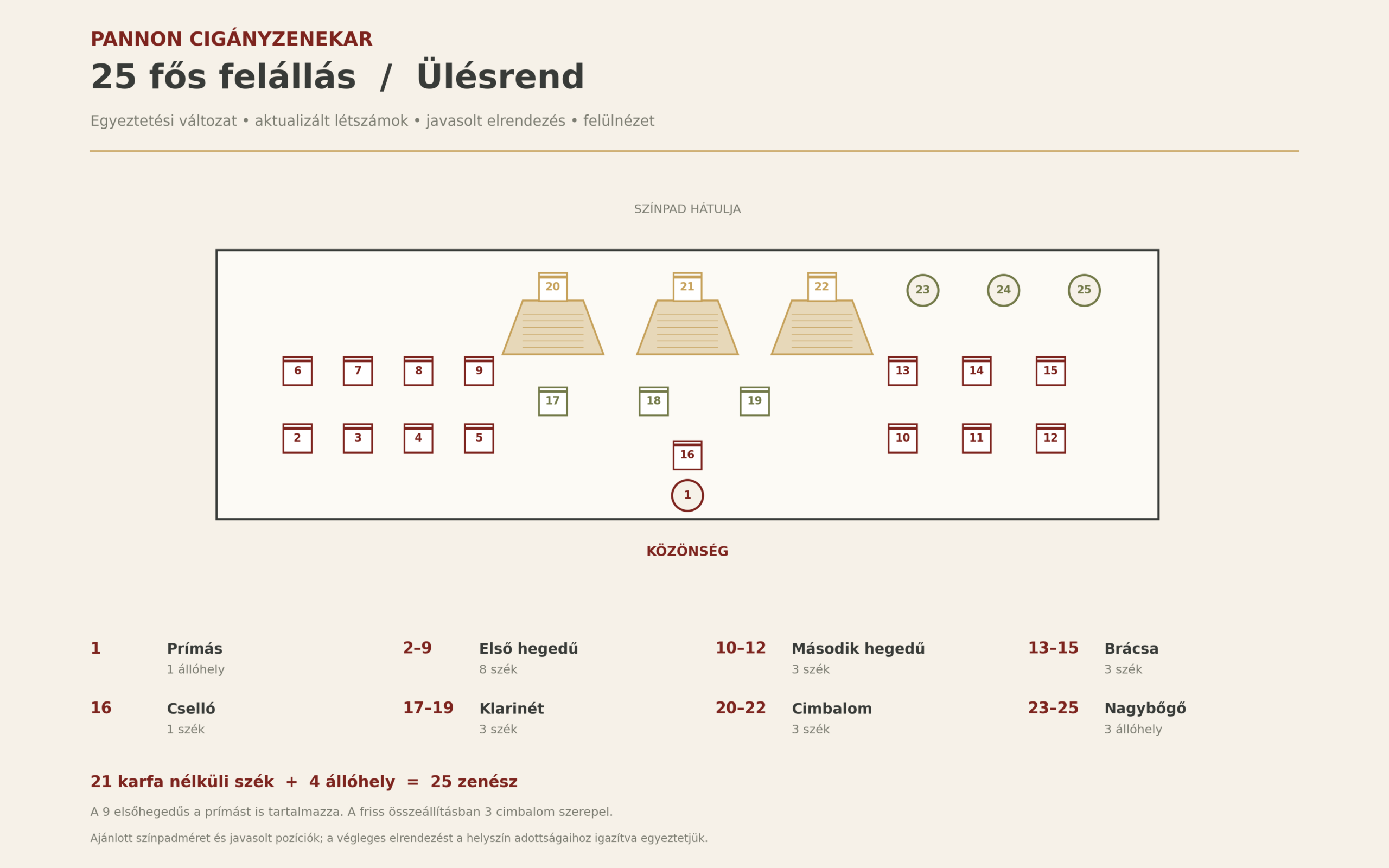
Proposed seating plan for the 25-piece ensemble, viewed from the audience. The musicians require 21 armless chairs and 4 standing positions. The arrangement is agreed to suit the venue.
Technical stage plan
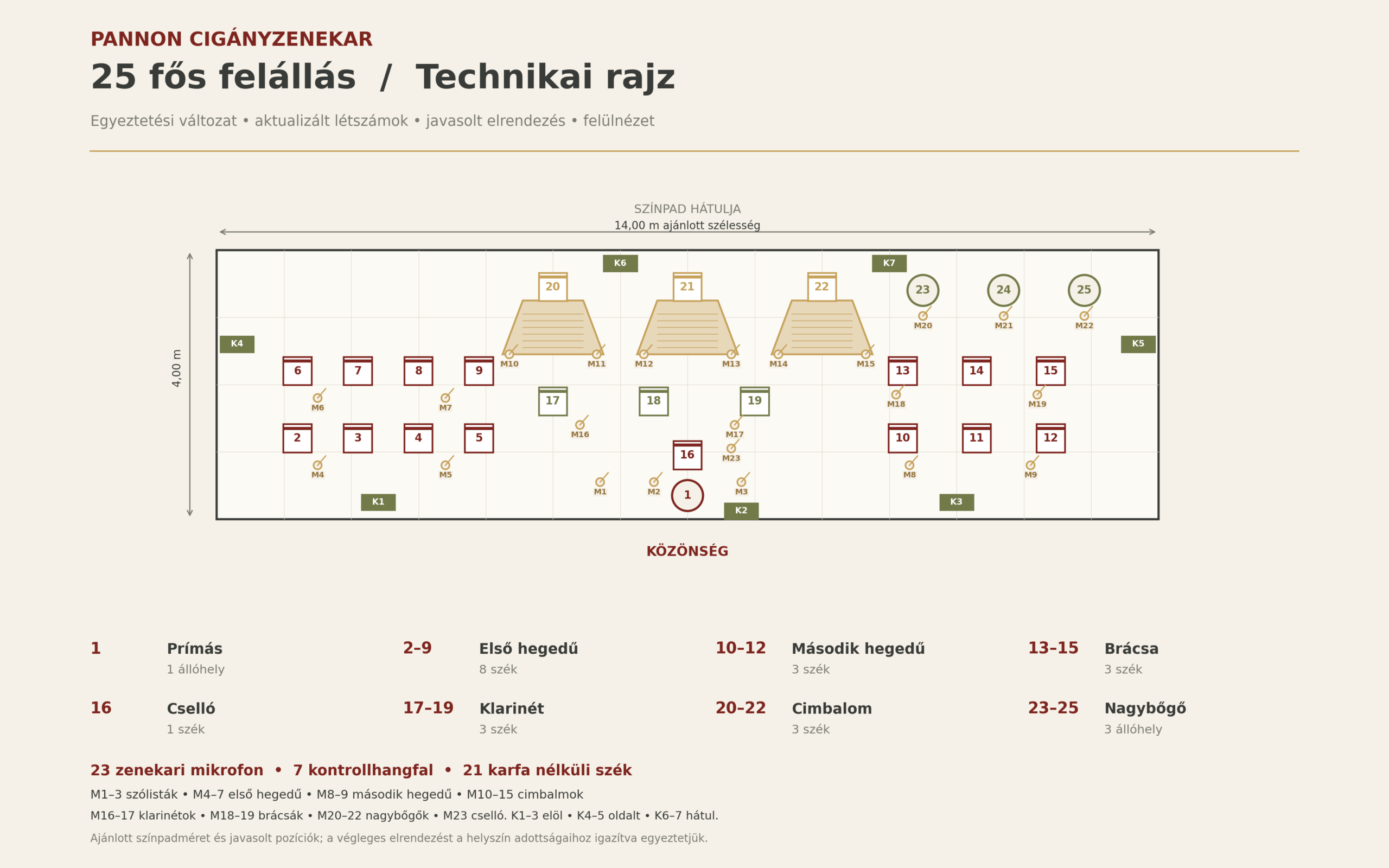
Proposed technical layout for the 25-piece Hungarian Royal Gypsy Orchestra. Recommended stage size: 14 metres wide × 4 metres deep; 21 armless chairs, 4 standing positions, 23 orchestra microphones and 7 stage monitors.
Microphone allocation by instrument and monitor positions are set out in the technical description. Additional microphones for guest artists are agreed separately. The final microphone setup, equipment positions and cabling are agreed with the venue technical team.
3D stage visualisation
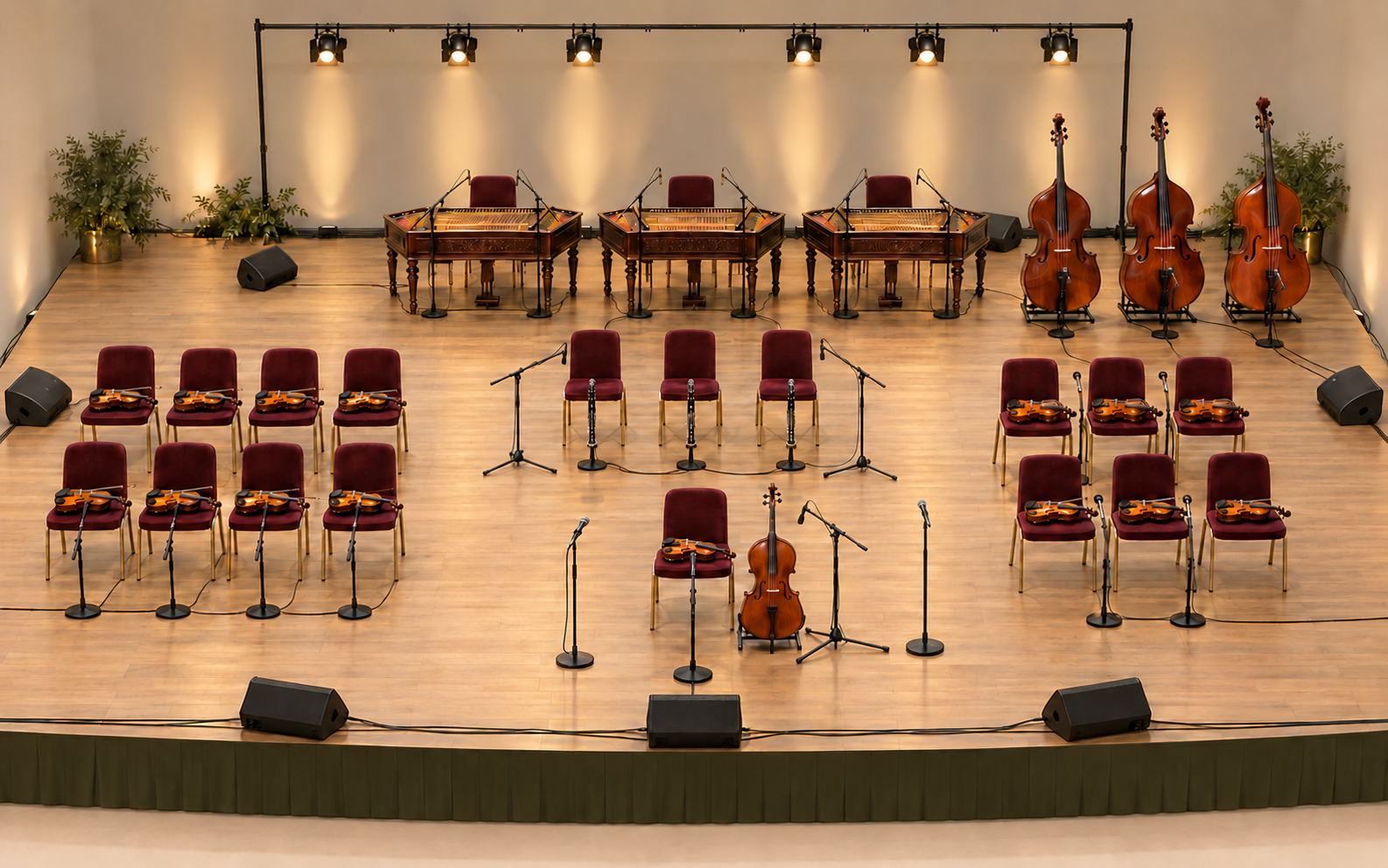
Illustrative stage visualisation for the 25-piece ensemble, with 3 cimbaloms and stage equipment. The image shows the stage before the performance, without musicians. The final layout, lighting and equipment are agreed to suit the venue; the precise requirements are set out in the written description and technical stage plan.
Production Information
17-piece ensemble
The 17-piece Hungarian Royal Gypsy Orchestra brings together strings, two cimbaloms and two clarinets in a varied concert programme. We recommend it for standalone concerts, festive occasions and cultural events. The programme and playing time are tailored to the occasion.
- 17 musicians
- 14 armless chairs
- 15 orchestra microphones
- 7 stage monitors
- Recommended stage size: 14 × 4 m
Programme
Instrumentation
1 primás (lead violinist) and 5 additional first violinists – 6 musicians in the first violin section in total
2 second violinists
2 viola players
1 cellist
2 double bass players
2 clarinettists
2 cimbalom players
17 musicians in total. In the 17-piece ensemble, the lead violinist is additional to the five first violinists. Guest artists may be arranged separately.
Programme formats and repertoire
We offer standalone stage concerts, festive and themed programmes, cultural events, school demonstrations, background music for events and accompaniment for dancing. The programme is tailored to the occasion, the audience and the booking request.
The repertoire includes traditional Hungarian Gypsy music, csárdás, Hungarian dances, operetta selections and popular classical works. Examples: Ferenc Erkel – Palotás; Brahms – Hungarian Dances; Franz Liszt – Hungarian Rhapsody No. 2; Johann Strauss – The Blue Danube; Vittorio Monti – Csárdás; Grigoraș Dinicu – The Lark.
Individual programme requests, guest artists and the named performers to be advertised are agreed in advance.
Playing time and intervals
Shorter event or demonstration programme: usually 45 minutes.
Standalone concert: usually two 45-minute sets with a 15-minute interval; approximately 105 minutes in total.
The exact playing time, number of sets and breaks are agreed to suit the event.
Stage and seating
Stage arrangement
Recommended stage size: 14 metres wide × 4 metres deep. This is a planning recommendation. The final layout and venue suitability are agreed in advance.
Viewed from the audience, the lead violinist stands at the front centre. First violins are on the left, with second violins and violas on the right. The cello is centrally placed behind the lead violinist. The 2 cimbaloms occupy the rear centre, the clarinets the rear centre and the double basses the rear right.
The stage must be dry, stable and safely accessible. Allow sufficient space between instruments and technical equipment for playing and clear access routes. Loading access and any risers are agreed separately.
Chairs and other equipment
The organiser provides 14 armless chairs. The lead violinist and double bass players perform standing, requiring 3 standing positions in total
Armless chairs are also suitable for the cimbalom players and cellist; no special seating is required. Music stands are used only by prior request; the required number will be confirmed separately.
Outdoor requirements
A covered stage is required for every outdoor performance. In windy conditions or light rain, enclosed sides must protect the musicians and their instruments.
Outdoor performances with the acoustic instruments are not possible at temperatures below 18 °C. The stage must remain dry and stable. The suitability of the venue and the weather conditions is agreed in advance.
Sound and lighting
Microphones and sound reinforcement
Amplified performances require 15 orchestra microphones in total:
2 for soloists / lead violinists
2 for first violins
1 for second violins
4 for the 2 cimbaloms – 2 per instrument
1 for clarinets
2 for violas
2 for double basses
1 for the cello
Stand-mounted microphones are the default arrangement. Suspended microphones may be used where suitable rigging is available and the technician agrees this with the orchestra in advance. Microphone types, stands, cabling and the final input list are agreed with the venue technician.
Microphones for guest singers or other additional performers are agreed separately and are additional to these 15 microphones.
A concert hall with suitable acoustics may allow an unamplified performance. Amplification is required in theatre venues and outdoors. The organiser provides a suitable PA system and sound technician.
Stage monitor placement
7 stage monitors are required: 3 at the front of the stage facing the musicians; 1 on each side in the middle of the stage; and 2 behind the orchestra.
Exact positions, monitor mixes and levels are agreed with the venue technician.
Lighting and power supply
The organiser provides suitable stage lighting for the musicians. There are no fixed special lighting requirements; lighting is agreed to suit the venue and the event.
The venue technician plans power supplies, connections, distribution and cabling for the sound and lighting equipment. Cables must not obstruct the musicians or access to the stage.
Organisation and contact
Load-in, soundcheck and load-out
Indicative timings at the venue:
Loading in and moving into dressing rooms: approximately 35 minutes.
Setting up and adjusting the orchestra sound: approximately 35–40 minutes.
With a guest singer, allow an additional 10–15 minutes depending on their requirements.
Striking and loading out: approximately 45 minutes, including vacating dressing rooms.
No separate sound rehearsal is needed if the sound setup is satisfactory. These are general estimates; arrival, time allowances and changeovers between performers are agreed for the specific ensemble and event.
Travel, dressing room, hospitality and accommodation
The orchestra travels from Budapest. This ensemble travels with 17 musicians; any guest artists or accompanying organiser or manager are included in the total travelling party by separate agreement. We do not bring technical crew; the client provides the venue technician.
Performances are available throughout Hungary, abroad and on multi-day tours. Travel and instrument transport arrangements are set out in the quotation. Please provide loading access and parking as close to the venue as possible.
The organiser provides dressing rooms suitable for the number of musicians. We request mineral water, soft drinks and coffee; sandwiches for longer journeys; and a hot dinner after the concert.
For distant venues or multi-day tours, the client provides accommodation. Room allocation, the number of nights and individual catering needs are agreed in advance.
Enquiries and booking terms
Each performance is quoted individually. Please include the proposed date, venue, event type, chosen ensemble and required playing time in your enquiry. Where possible, contact us one to two months before the event.
The performance is confirmed once both parties have signed the contract. Public announcements may follow confirmation.
Travel and instrument transport may be included in the quotation as agreed. The client provides any required accommodation and covers the fees of requested guest artists. Technical services and other commitments are recorded in the quotation and contract, together with payment, cancellation and weather terms.
Photography, recording and broadcasting
Concert photography, audio or video recording and live streaming are possible by prior mutual agreement between the orchestra and the organiser. Proposed recording, use and publication arrangements must be agreed with Lajos Baranyai.
Contact
Contact for bookings and artistic, organisational or technical enquiries: Lajos Baranyai.
Please use the contact details or booking enquiry form on the Contact page of our website. Arrangements are discussed in Hungarian; assistance is provided for enquiries in other languages.
Seating plan
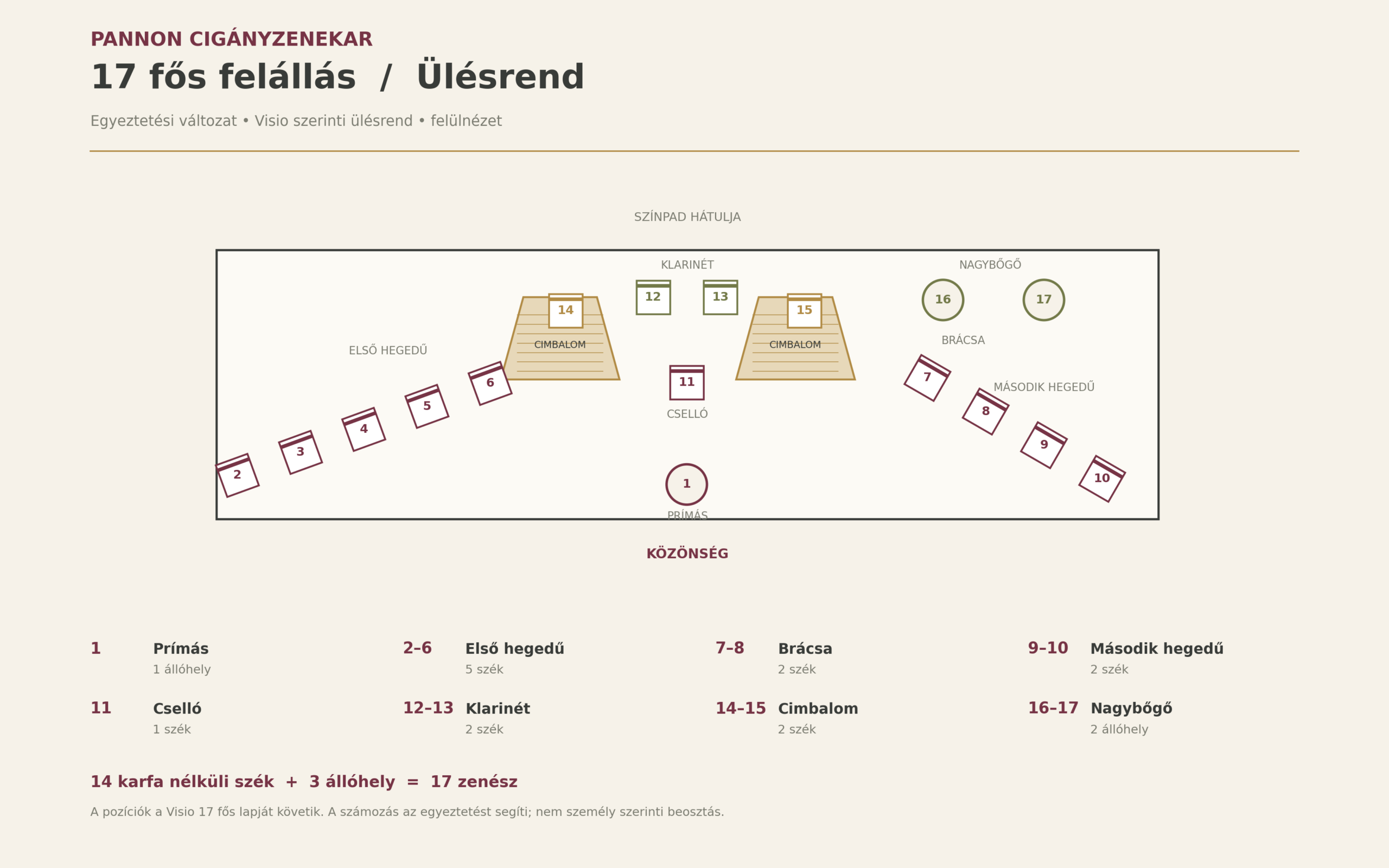
Proposed seating plan for the 17-piece ensemble, viewed from the audience. The musicians require 14 armless chairs and 3 standing positions. The arrangement is agreed to suit the venue.
Technical stage plan
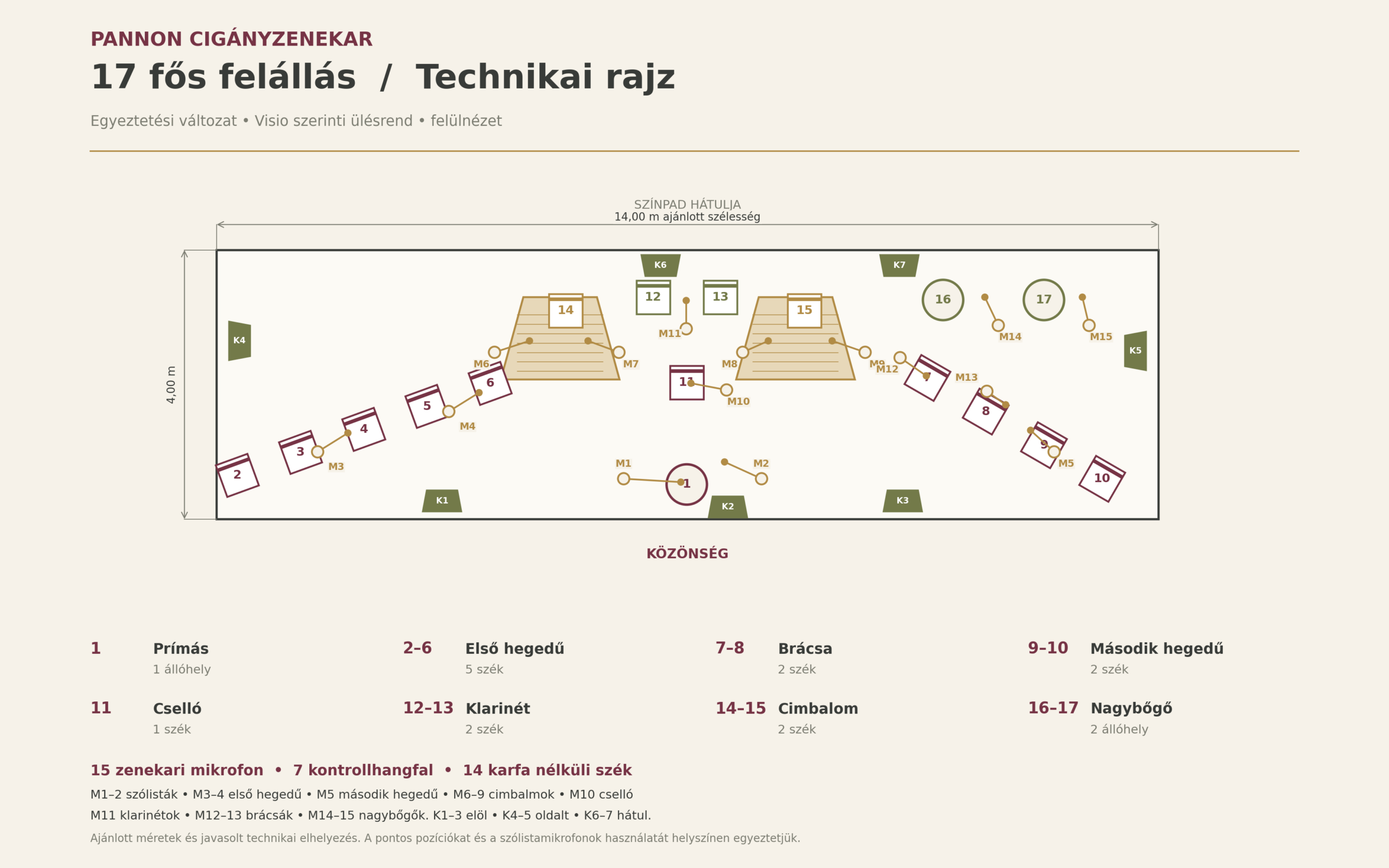
Proposed technical layout for the 17-piece Hungarian Royal Gypsy Orchestra. Recommended stage size: 14 metres wide × 4 metres deep; 14 armless chairs, 3 standing positions, 15 orchestra microphones and 7 stage monitors.
Microphone allocation by instrument and monitor positions are set out in the technical description. Additional microphones for guest artists are agreed separately. The final microphone setup, equipment positions and cabling are agreed with the venue technical team.
3D stage visualisation
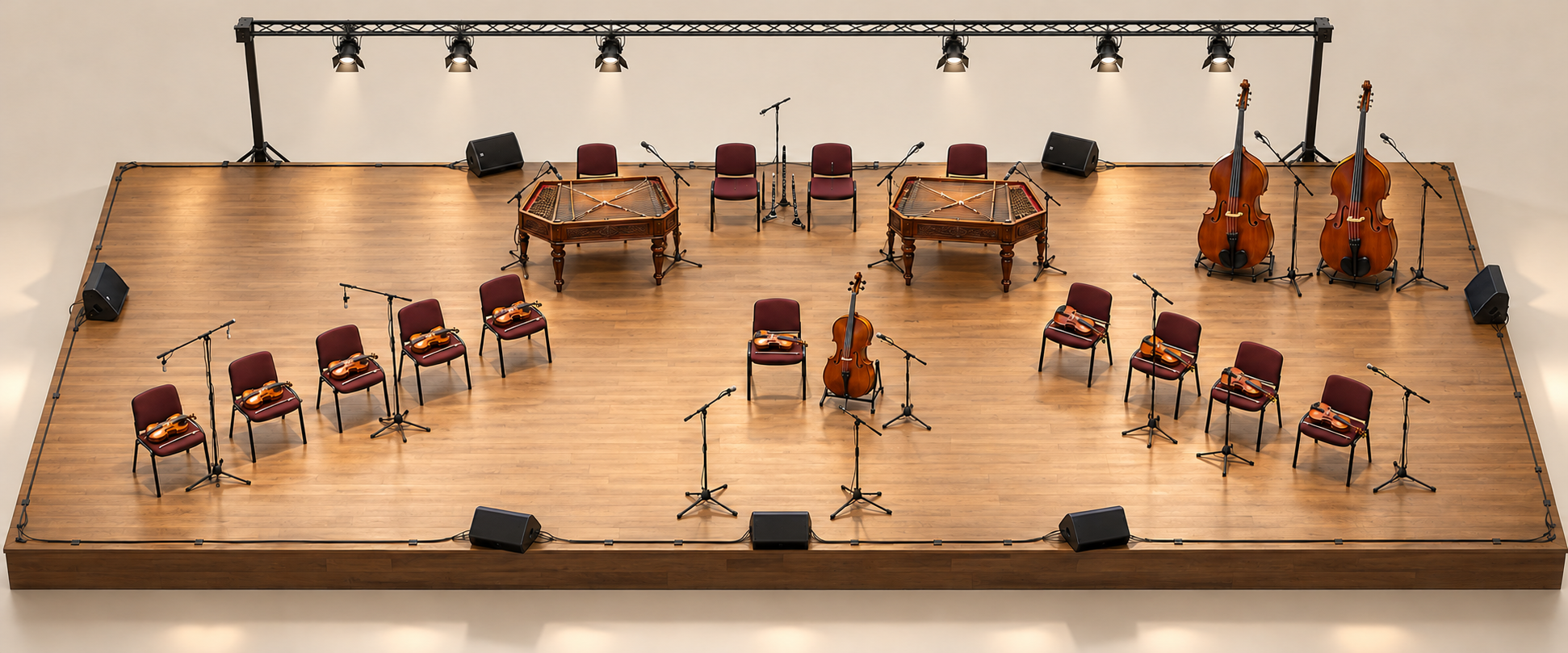
Illustrative stage visualisation for the 17-piece ensemble, with 2 cimbaloms and stage equipment. The image shows the stage before the performance, without musicians. The final layout, lighting and equipment are agreed to suit the venue; the precise requirements are set out in the written description and technical stage plan.
Production Information
7-piece ensemble
The seven-piece Hungarian Royal Gypsy Orchestra brings together violin, viola, cello, double bass, clarinet and cimbalom in a compact ensemble. We recommend it for smaller events, demonstrations, background music or accompaniment for dancing. The programme and playing time are tailored to the occasion.
- 7 musicians
- 5 armless chairs
- 8 orchestra microphones
- 1 stage monitors
- Recommended stage size: 7 × 3 m
Programme
Instrumentation
1 primás (lead violinist)
1 second violinist
1 viola player
1 cellist
1 double bass player
1 clarinettist
1 cimbalom player
7 musicians in total. The lead violinist is the only player in the first violin section. Guest artists may be arranged separately.
Programme formats and repertoire
We offer standalone stage concerts, festive and themed programmes, cultural events, school demonstrations, background music for events and accompaniment for dancing. The programme is tailored to the occasion, the audience and the booking request.
The repertoire includes traditional Hungarian Gypsy music, csárdás, Hungarian dances, operetta selections and popular classical works. Examples: Ferenc Erkel – Palotás; Brahms – Hungarian Dances; Franz Liszt – Hungarian Rhapsody No. 2; Johann Strauss – The Blue Danube; Vittorio Monti – Csárdás; Grigoraș Dinicu – The Lark.
Individual programme requests, guest artists and the named performers to be advertised are agreed in advance.
Playing time and intervals
Shorter event or demonstration programme: usually 45 minutes.
Standalone concert: usually two 45-minute sets with a 15-minute interval; approximately 105 minutes in total.
The exact playing time, number of sets and breaks are agreed to suit the event.
Stage and seating
Stage arrangement
Recommended stage size: 7 metres wide × 3 metres deep. This is a planning recommendation. The final layout and venue suitability are agreed in advance.
Viewed from the audience, the lead violinist stands at the front centre. The second violinist and viola player may sit to either side; cello and clarinet may be placed centrally or to the side. The cimbalom may sit at the rear centre, with the double bass to one side at the rear. The compact arrangement is adapted to maintain sightlines and ensemble communication.
The stage must be dry, stable and safely accessible. Allow sufficient space between instruments and technical equipment for playing and clear access routes. Loading access and any risers are agreed separately.
Chairs and other equipment
The organiser provides 5 armless chairs. The lead violinist and double bass players perform standing, requiring 2 standing positions in total.
Armless chairs are also suitable for the cimbalom players and cellist; no special seating is required. Music stands are used only by prior request; the required number will be confirmed separately.
Outdoor requirements
A covered stage is required for every outdoor performance. In windy conditions or light rain, enclosed sides must protect the musicians and their instruments.
Outdoor performances with the acoustic instruments are not possible at temperatures below 18 °C. The stage must remain dry and stable. The suitability of the venue and the weather conditions is agreed in advance.
Sound and lighting
Microphones and sound reinforcement
Amplified performances require 8 orchestra microphones in total:
1 wireless instrument microphone for the lead violinist
2 clip-on microphones for the cimbalom
1 for the second violin
1 for the viola
1 for the clarinet
1 for the double bass
1 for the cello
Microphone types and mounting for the remaining instruments, stands, cabling and the final input list are agreed with the venue technician.
Microphones for guest singers or other additional performers are agreed separately and are additional to these 8 microphones.
A concert hall with suitable acoustics may allow an unamplified performance. Amplification is required in theatre venues and outdoors. The organiser provides a suitable PA system and sound technician.
Stage monitor placement
1 stage monitor is required in a suitable position agreed in advance.
Exact positions, monitor mixes and levels are agreed with the venue technician.
Lighting and power supply
The organiser provides suitable stage lighting for the musicians. There are no fixed special lighting requirements; lighting is agreed to suit the venue and the event.
The venue technician plans power supplies, connections, distribution and cabling for the sound and lighting equipment. Cables must not obstruct the musicians or access to the stage.
Organisation and contact
Load-in, soundcheck and load-out
Indicative timings at the venue:
Loading in and moving into dressing rooms: approximately 35 minutes.
Setting up and adjusting the orchestra sound: approximately 35–40 minutes.
With a guest singer, allow an additional 10–15 minutes depending on their requirements.
Striking and loading out: approximately 45 minutes, including vacating dressing rooms.
No separate sound rehearsal is needed if the sound setup is satisfactory. These are general estimates; arrival, time allowances and changeovers between performers are agreed for the specific ensemble and event.
Travel, dressing room, hospitality and accommodation
The orchestra travels from Budapest. This ensemble travels with 7 musicians; any guest artists or accompanying organiser or manager are included in the total travelling party by separate agreement. We do not bring technical crew; the client provides the venue technician.
Performances are available throughout Hungary, abroad and on multi-day tours. Travel and instrument transport arrangements are set out in the quotation. Please provide loading access and parking as close to the venue as possible.
The organiser provides dressing rooms suitable for the number of musicians. We request mineral water, soft drinks and coffee; sandwiches for longer journeys; and a hot dinner after the concert.
For distant venues or multi-day tours, the client provides accommodation. Room allocation, the number of nights and individual catering needs are agreed in advance.
Enquiries and booking terms
Each performance is quoted individually. Please include the proposed date, venue, event type, chosen ensemble and required playing time in your enquiry. Where possible, contact us one to two months before the event.
The performance is confirmed once both parties have signed the contract. Public announcements may follow confirmation.
Travel and instrument transport may be included in the quotation as agreed. The client provides any required accommodation and covers the fees of requested guest artists. Technical services and other commitments are recorded in the quotation and contract, together with payment, cancellation and weather terms.
Photography, recording and broadcasting
Concert photography, audio or video recording and live streaming are possible by prior mutual agreement between the orchestra and the organiser. Proposed recording, use and publication arrangements must be agreed with Lajos Baranyai.
Contact
Contact for bookings and artistic, organisational or technical enquiries: Lajos Baranyai.
Please use the contact details or booking enquiry form on the Contact page of our website. Arrangements are discussed in Hungarian; assistance is provided for enquiries in other languages.
Seating plan
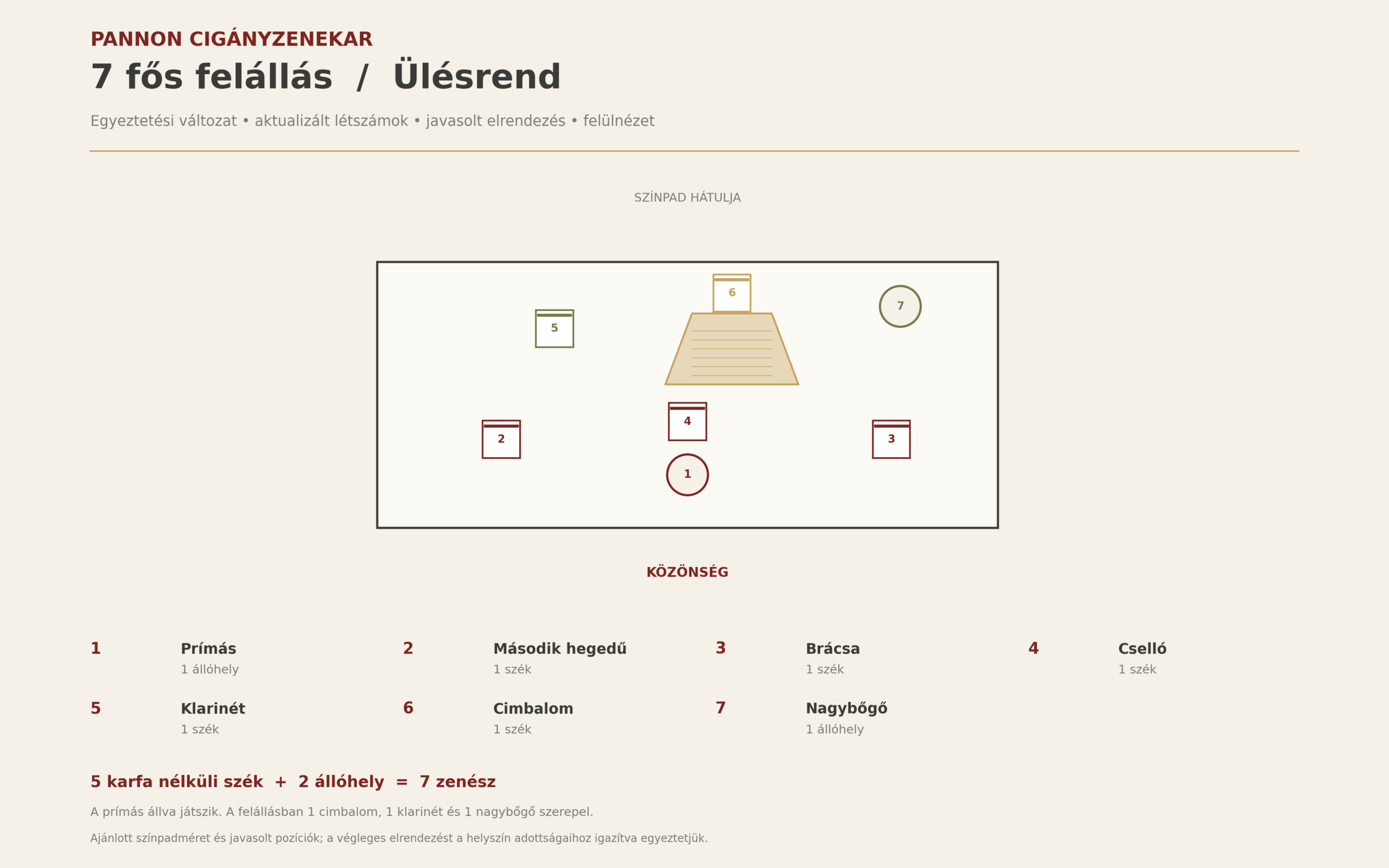
Proposed seating plan for the 7-piece ensemble, viewed from the audience. The musicians require 5 armless chairs and 2 standing positions. The arrangement is agreed to suit the venue.
Technical stage plan
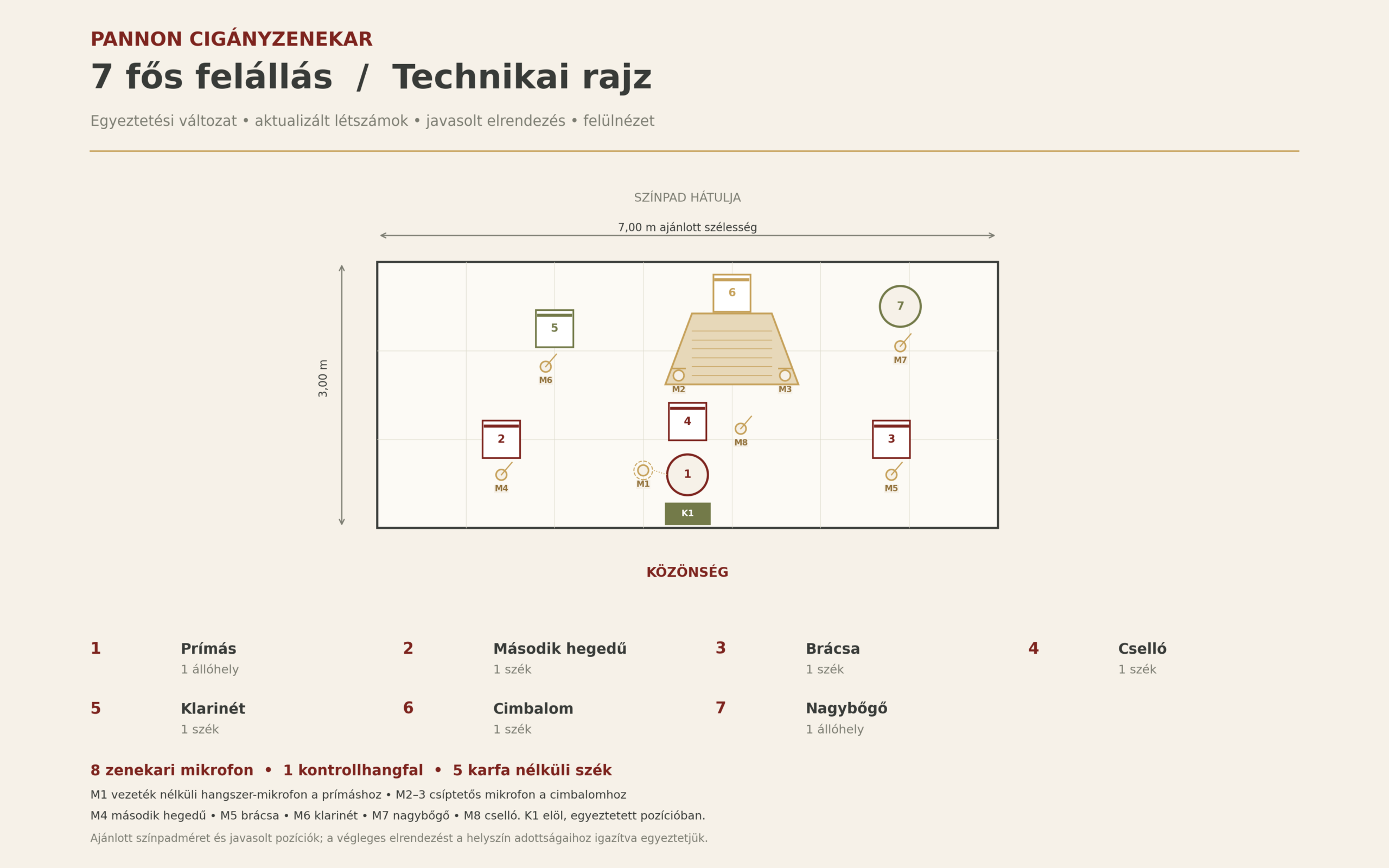
Proposed technical layout for the 7-piece Hungarian Royal Gypsy Orchestra. Recommended stage size: 7 metres wide × 3 metres deep; 5 armless chairs, 2 standing positions, 8 orchestra microphones and 1 stage monitor.
Microphone allocation by instrument and monitor positions are set out in the technical description. Additional microphones for guest artists are agreed separately. The final microphone setup, equipment positions and cabling are agreed with the venue technical team.
3D stage visualisation
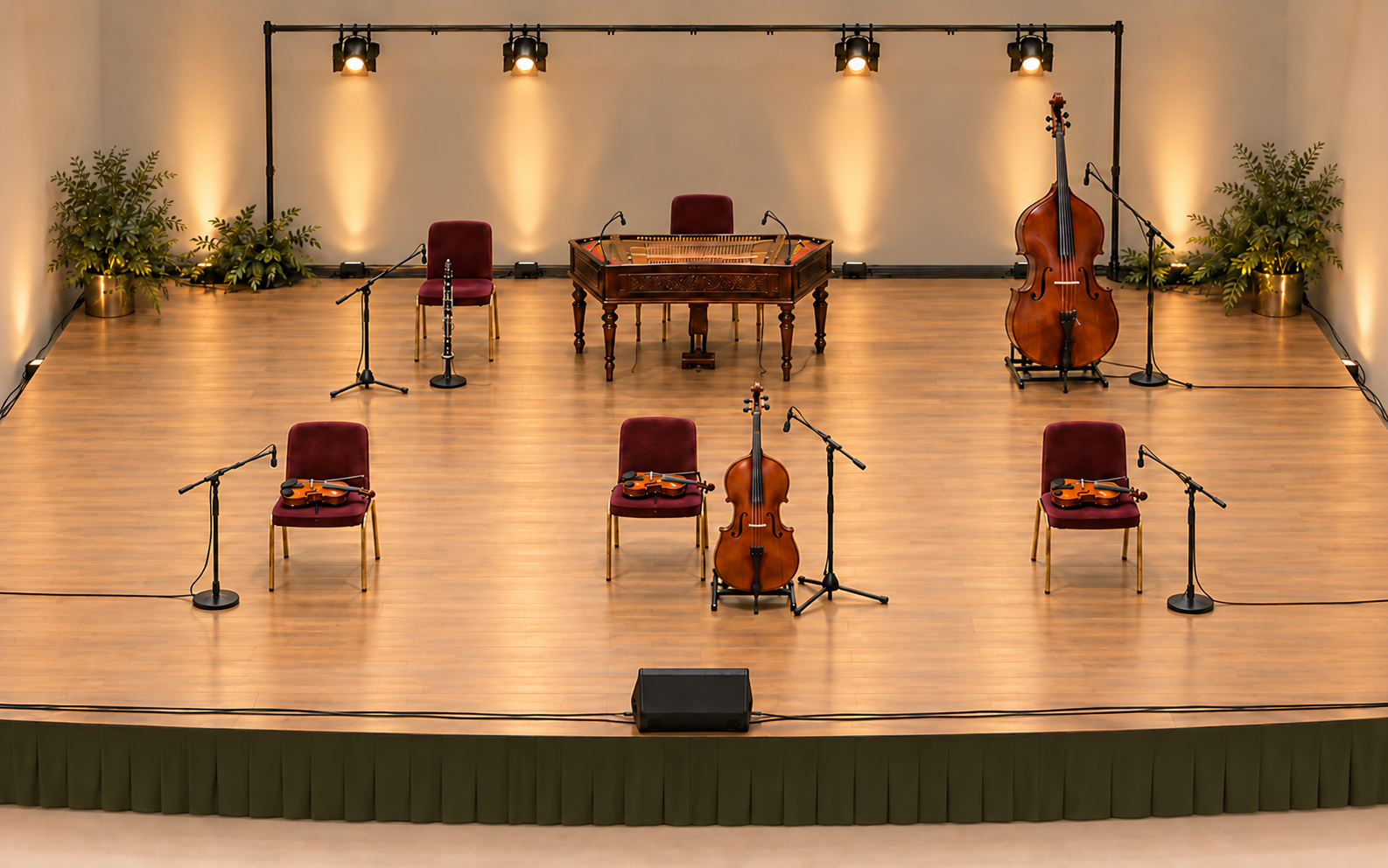
Illustrative stage visualisation for the 7-piece ensemble, with 1 cimbalom and stage equipment. The image shows the stage before the performance, without musicians. The final layout, lighting and equipment are agreed to suit the venue; the precise requirements are set out in the written description and technical stage plan.
Production Information
Custom ensemble
We can create a custom orchestra ensemble for your event. The number of musicians, instrument balance, programme and venue requirements are agreed with the client. A written production description is prepared for the final ensemble.
Programme
Instrumentation
The number of musicians and instrumental line-up are agreed according to the programme, occasion, venue and available players. Participation of the lead violinist, string sections, cimbalom and clarinet is set out in the accepted quotation. Guest artists may be arranged separately.
Programme formats and repertoire
We offer standalone stage concerts, festive and themed programmes, cultural events, school demonstrations, background music for events and accompaniment for dancing. The programme is tailored to the occasion, the audience and the booking request.
The repertoire includes traditional Hungarian Gypsy music, csárdás, Hungarian dances, operetta selections and popular classical works. Examples: Ferenc Erkel – Palotás; Brahms – Hungarian Dances; Franz Liszt – Hungarian Rhapsody No. 2; Johann Strauss – The Blue Danube; Vittorio Monti – Csárdás; Grigoraș Dinicu – The Lark.
Individual programme requests, guest artists and the named performers to be advertised are agreed in advance.
Playing time and intervals
Shorter event or demonstration programme: usually 45 minutes.
Standalone concert: usually two 45-minute sets with a 15-minute interval; approximately 105 minutes in total.
The exact playing time, number of sets and breaks are agreed to suit the event.
Stage and seating
Stage arrangement
The recommended stage dimensions and arrangement are determined by the final number of musicians, instruments and venue. This ensemble has no fixed seating graphic, technical stage drawing or 3D visualisation; the agreed arrangement is described in writing.
The stage must be dry, stable and safely accessible. Allow sufficient space for playing and clear access routes. Loading access and any risers are agreed separately.
Chairs and other equipment
The number of armless chairs and standing positions is determined by the final instrumental line-up. The organiser provides the chairs. Music stands are used only by prior request; their number and any other furniture requirements are agreed separately.
Outdoor requirements
A covered stage is required for every outdoor performance. In windy conditions or light rain, enclosed sides must protect the musicians and their instruments.
Outdoor performances with the acoustic instruments are not possible at temperatures below 18 °C. The stage must remain dry and stable. The suitability of the venue and the weather conditions is agreed in advance.
Sound and lighting
Microphones and sound reinforcement
Microphone numbers, allocation by instrument and types are determined for the final ensemble and venue. Guest artists’ microphone requirements are recorded separately. Stands, cabling and the input list are agreed with the venue technician.
A concert hall with suitable acoustics may allow an unamplified performance. Amplification is required in theatre venues and outdoors. The organiser provides a suitable PA system and sound technician.
Stage monitor placement
Stage monitor numbers, positions and monitor mixes are agreed with the technician according to the final ensemble and the facilities at the venue.
Lighting and power supply
The organiser provides suitable stage lighting for the musicians. There are no fixed special lighting requirements; lighting is agreed to suit the venue and the event.
The venue technician plans power supplies, connections, distribution and cabling for the sound and lighting equipment. Cables must not obstruct the musicians or access to the stage.
Organisation and contact
Load-in, soundcheck and load-out
Indicative timings at the venue:
Loading in and moving into dressing rooms: approximately 35 minutes.
Setting up and adjusting the orchestra sound: approximately 35–40 minutes.
With a guest singer, allow an additional 10–15 minutes depending on their requirements.
Striking and loading out: approximately 45 minutes, including vacating dressing rooms.
No separate sound rehearsal is needed if the sound setup is satisfactory. These are general estimates; arrival, time allowances and changeovers between performers are agreed for the specific ensemble and event.
Travel, dressing room, hospitality and accommodation
The orchestra travels from Budapest. The total travelling party is agreed according to the confirmed ensemble, guest artists and any accompanying organiser or manager. We do not bring technical crew; the client provides the venue technician.
Performances are available throughout Hungary, abroad and on multi-day tours. Travel and instrument transport arrangements are recorded in the quotation. Please provide loading access and parking as close to the venue as possible.
The organiser provides dressing rooms suitable for the number of musicians. We request mineral water, soft drinks and coffee; sandwiches for longer journeys; and a hot dinner after the concert. For distant venues or multi-day tours, the client provides accommodation. Room allocation, the number of nights and individual catering needs are agreed in advance.
Enquiries and booking terms
Each performance is quoted individually. Please include the proposed date, venue, event type, chosen ensemble and required playing time in your enquiry. Where possible, contact us one to two months before the event.
The performance is confirmed once both parties have signed the contract. Public announcements may follow confirmation.
Travel and instrument transport may be included in the quotation as agreed. The client provides any required accommodation and covers the fees of requested guest artists. Technical services and other commitments are recorded in the quotation and contract, together with payment, cancellation and weather terms.
Photography, recording and broadcasting
Concert photography, audio or video recording and live streaming are possible by prior mutual agreement between the orchestra and the organiser. Proposed recording, use and publication arrangements must be agreed with Lajos Baranyai.
Contact
Contact for bookings and artistic, organisational or technical enquiries: Lajos Baranyai.
Please use the contact details or booking enquiry form on the Contact page of our website. Arrangements are discussed in Hungarian; assistance is provided for enquiries in other languages.