Clarinet, Tárogató – President
Pannon Portrait
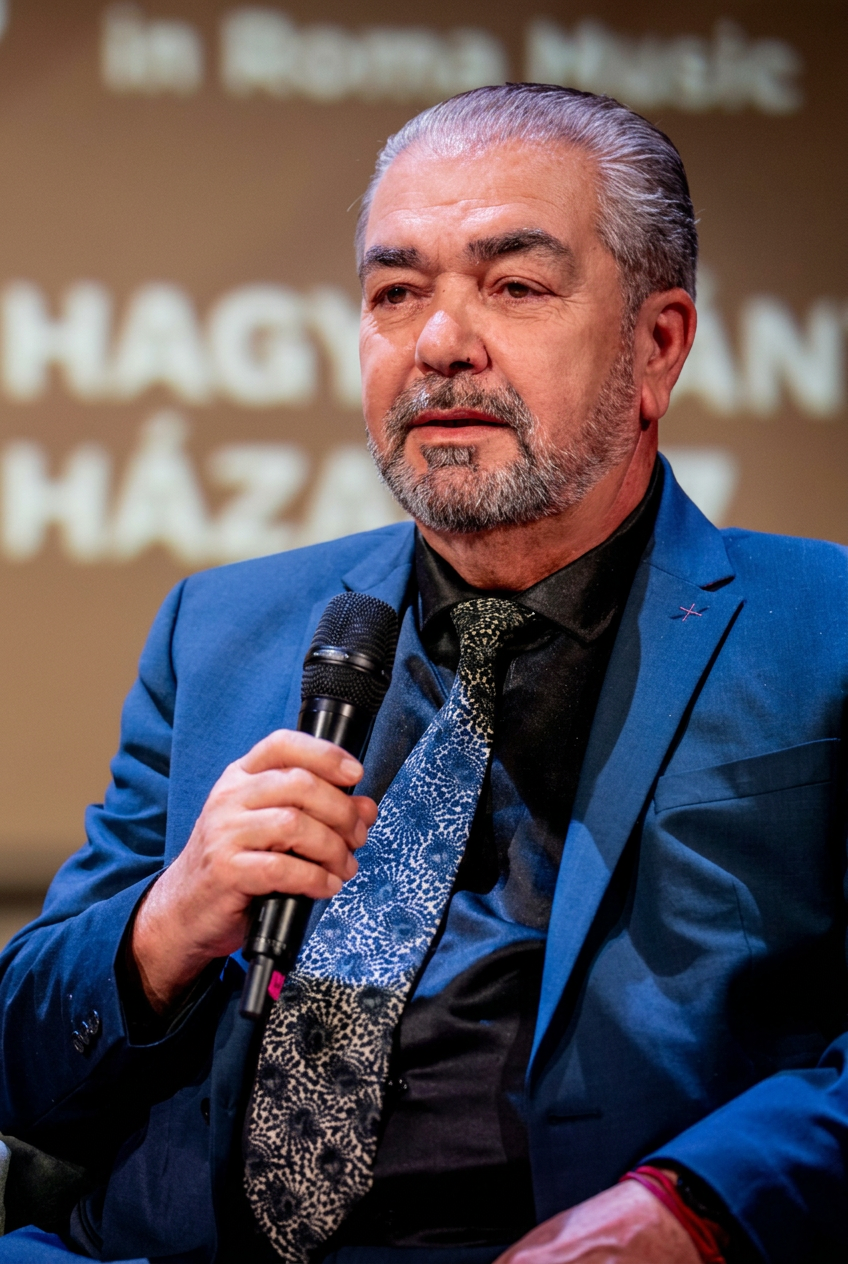
Clarinet and tárogató player, founder and leader of the Pannon Cigányzenekar. He joined the Rajkó Orchestra at the age of fourteen and became a soloist shortly afterwards. During a career spanning several decades, he has performed in numerous countries and shared the stage with many outstanding figures of Hungarian Roma music.
Career
Clarinet and tárogató player Baranyai Lajos was born on 26 March 1961 in Szombathely, the eldest of three children in a distinguished musical family on both his mother’s and father’s side. His father, Baranyai Lajos Sr., was a respected double bassist, while his mother, H. Erzsébet, played the violin. His younger brother continued the family’s musical tradition as a cimbalom player, while his sister chose a profession outside music.
At the age of ten, Baranyai Lajos began studying the clarinet at the Bartók Béla Music School in Szombathely, where he was taught by Simon Géza. At the same time, under the guidance of Tamás József, he became immersed in the distinctive musical language and performance traditions of Hungarian Roma music.
At just fourteen, he was admitted to the world-renowned Rajkó Orchestra. Thanks to his exceptional talent, within only two months he was already performing as a soloist. During his years with the ensemble, he toured extensively abroad. His musical development was profoundly influenced by Farkas Gyula, the legendary founder and artistic director of the Rajkó Orchestra, and later by clarinetist Vámos Péter, a member of the Hungarian State Concert Orchestra.
He completed his military service as a member of the Aquincum Artistic Ensemble. Afterwards, he joined Mici Farkas Gyula’s orchestra at the Baricska Csárda in Balatonfüred, followed by numerous engagements with leading musicians and ensembles. He performed with Petrik József at Hotel Európa, with Puka Károly and Salasovics Dezső at the Hungária Café, with Németh Gyula at the EMKE Restaurant, with ifj. Déki Lakatos Sándor at the Trombitás Restaurant, and with Déki Lakatos Sándor and Lakatos Sándor at the Mátyás Pince. Throughout his career, he has also worked alongside outstanding musicians including Berki Béla, Suki András, Lendvai “Csócsi” Jenő and József, Molnár László and Ökrös Oszkár.
In 1989, he performed in Hamburg, where his playing was broadcast live by local radio.
One of the defining milestones of his career came in 2006, when he founded the Pannon Cigányzenekar. The ensemble grew to become one of Hungary’s largest Roma orchestras after the 100 Member Gypsy Orchestra. As its founder and leader, Baranyai Lajos has spent two decades working to preserve the traditions of Hungarian Roma music, keep them alive on the concert stage and support the next generation of musicians.
His musical world extends far beyond classical music and traditional Hungarian café and Roma music. Baranyai Lajos is equally at home performing with folk and popular music ensembles. In addition to the clarinet, he plays the tárogató and saxophone, and frequently brings all three instruments to his performances. This versatility allows him to enrich ensembles across a wide range of musical styles, choosing the instrument and sound that best suits each musical setting.
Baranyai Lajos currently lives in Bük and is the father of two children.
With the Pannon Orchestra
Baranyai Lajos founded the Pannon Cigányzenekar in 2006. For twenty years, he has led the ensemble with the aim of securing a worthy place for the living tradition of Hungarian Roma music on concert stages in Hungary and abroad, while placing particular emphasis on supporting young musicians and passing this musical heritage on to future generations.
Awards and Honours
2008 – Certificate of Recognition from the Hungarian Minister of Education and Culture
Something Few People Know About Me
Although most people know me as a clarinetist, I rarely arrive on stage with just one instrument. In addition to the clarinet, I play the tárogató and saxophone, and I often bring all three with me to performances. Alongside traditional Hungarian Roma music, I enjoy performing folk and popular music as well – choosing whichever instrument best captures the character of the musical moment.